Draw an Equilateral Triangle and Its Inscribed and Circumscribed Circles
2.5: Circumscribed and Inscribed Circles
- Page ID
- 3258
Recall from the Law of Sines that any triangle \(\triangle\,ABC\) has a common ratio of sides to sines of opposite angles, namely
\[\nonumber
\frac{a}{\sin\;A} ~=~ \frac{b}{\sin\;B} ~=~ \frac{c}{\sin\;C} ~.
\]
This common ratio has a geometric meaning: information technology is the bore (i.e. twice the radius) of the unique circle in which \(\triangle\,ABC\) can be inscribed, chosen the circumscribed circle of the triangle. Before proving this, we need to review some elementary geometry.
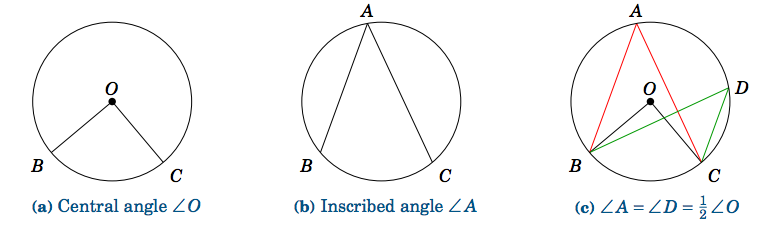
An inscribed angle of a circumvolve is an angle whose vertex is a bespeak \(A\) on the circle and whose sides are line segments (called chords) from \(A\) to ii other points on the circle. In Figure two.5.1(b), \(\angle\,A\) is an inscribed angle that intercepts the arc \(\overparen{BC} \). We state hither without proof a useful relation between inscribed and central angles:
Theorem 2.4
If an inscribed angle \(\bending\,A\) and a central angle \(\angle\,O\) intercept the aforementioned arc, then \(\bending\,A = \frac{1}{2}\,\angle\,O\, \). Thus, inscribed angles which intercept the aforementioned arc are equal.
Figure 2.five.1(c) shows ii inscribed angles, \(\angle\,A\) and \(\angle\,D \), which intercept the same arc \(\overparen{BC}\) equally the cardinal bending \(\angle\,O \), and hence \(\angle\,A = \angle\,D = \frac{ane}{2}\,\angle\,O\) (so \(\;\angle\,O = 2\,\bending\,A = two\,\angle\,D\,) \).
We will at present bear witness our assertion almost the common ratio in the Law of Sines:
Theorem two.5
For any triangle \(\triangle\,ABC \), the radius \(R\) of its circumscribed circle is given by:
\[2\,R ~=~ \frac{a}{\sin\;A} ~=~ \frac{b}{\sin\;B} ~=~ \frac{c}{\sin\;C}\label{2.35}\]
Note: For a circle of diameter \(1 \), this ways \(a=\sin\;A \), \(b=\sin\;B \), and \(c=\sin\;C \).)
To testify this, let \(O\) exist the center of the circumscribed circumvolve for a triangle \(\triangle\,ABC \). And then \(O\) tin can be either inside, exterior, or on the triangle, every bit in Figure 2.five.2 below. In the kickoff ii cases, depict a perpendicular line segment from \(O\) to \(\overline{AB}\) at the betoken \(D \).
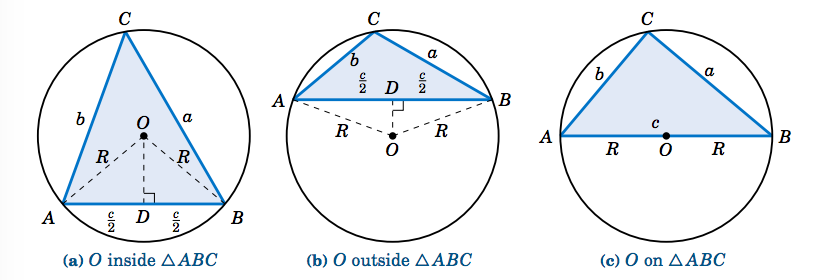
The radii \(\overline{OA}\) and \(\overline{OB}\) have the same length \(R \), then \(\triangle\,AOB\) is an isosceles triangle. Thus, from uncomplicated geometry we know that \(\overline{OD}\) bisects both the angle \(\angle\,AOB\) and the side \(\overline{AB} \). And so \(\bending\,AOD = \frac{1}{2}\,\bending\,AOB\) and \(Advertisement = \frac{c}{2} \). But since the inscribed angle \(\bending\,ACB\) and the central angle \(\angle\,AOB\) intercept the aforementioned arc \(\overparen{AB} \), we know from Theorem 2.4 that \(\angle\,ACB = \frac{ane}{two}\,\bending\,AOB \). Hence, \(\bending\,ACB = \angle\,AOD \). Then since \(C =\angle\,ACB \), nosotros have
\[\nonumber
\sin\;C ~=~ \sin\;\bending\,AOD ~=~ \frac{AD}{OA} ~=~ \frac{\frac{c}{2}}{R} ~=~ \frac{c}{2R}
\quad\Rightarrow\quad 2\,R ~=~ \frac{c}{\sin\;C} ~,
\]
so past the Law of Sines the outcome follows if \(O\) is inside or exterior \(\triangle\,ABC \).
At present suppose that \(O\) is on \(\triangle\,ABC \), say, on the side \(\overline{AB} \), as in Figure 2.v.ii(c). Then \(\overline{AB}\) is a diameter of the circumvolve, so \(C = 90^\circ\) by Thales' Theorem. Hence, \(\sin\;C = 1 \), then \(2\,R = AB = c = \frac{c}{one} = \frac{c}{\sin\;C}\; \), and the result again follows past the Law of Sines. QED
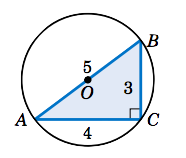
Solution:
We know that \(\triangle\,ABC\) is a right triangle. So as nosotros see from Figure two.five.3, \(\sin\;A = 3/v \). Thus,
\[ ii\,R ~=~ \frac{a}{\sin\;A} ~=~ \frac{iii}{\frac{3}{5}} ~=~ 5 \quad\Rightarrow\quad \boxed{R ~=~ two.five} ~.\nonumber \]
Note that since \(R =2.5 \), the diameter of the circle is \(5 \), which is the same as \(AB \). Thus, \(\overline{AB}\) must be a diameter of the circle, and so the eye \(O\) of the circle is the midpoint of \(\overline{AB} \).
Corollary two.six
For any right triangle, the hypotenuse is a bore of the confining circle, i.e. the center of the circle is the midpoint of the hypotenuse.
For the right triangle in the in a higher place example, the circumscribed circle is elementary to draw; its center can be plant by measuring a distance of \(ii.v\) units from \(A\) forth \(\overline{AB} \).
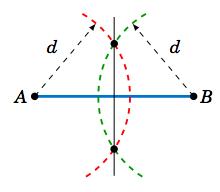
We need a different procedure for acute and obtuse triangles, since for an acute triangle the middle of the circumscribed circle will exist within the triangle, and it will be outside for an obtuse triangle. Notice from the proof of Theorem 2.5 that the center \(O\) was on the perpendicular bisector of ane of the sides (\(\overline{AB}\)). Similar arguments for the other sides would show that \(O\) is on the perpendicular bisectors for those sides:
Corollary 2.7
For whatsoever triangle, the center of its circumscribed circumvolve is the intersection of the perpendicular bisectors of the sides.
Case 2.18
Find the radius \(R\) of the circumscribed circle for the triangle \(\triangle\,ABC\) from Case 2.6 in Section ii.ii: \(a = 2 \), \(b = 3 \), and \(c = 4 \). Then draw the triangle and the circumvolve.
Solution:
In Example 2.6 we found \(A=28.9^\circ \), and so \(2\,R = \frac{a}{\sin\;A} = \frac{2}{\sin\;28.9^\circ} = 4.xiv \), so \(\boxed{R = 2.07}\; \).
In Figure 2.v.5(a) we show how to draw \(\triangle\,ABC\): use a ruler to draw the longest side \(\overline{AB}\) of length \(c=4 \), then use a compass to describe arcs of radius \(3\) and \(ii\) centered at \(A\) and \(B \), respectively. The intersection of the arcs is the vertex \(C \).
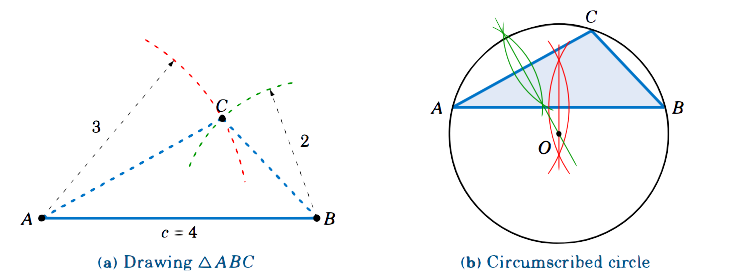
In Figure 2.5.5(b) nosotros bear witness how to draw the circumscribed circumvolve: draw the perpendicular bisectors of \(\overline{AB}\) and \(\overline{AC}\); their intersection is the centre \(O\) of the circle. Use a compass to draw the circle centered at \(O\) which passes through \(A \).
Theorem 2.5 can exist used to derive another formula for the area of a triangle:
Theorem 2.8
For a triangle \(\triangle\,ABC \), let \(K\) exist its area and let \(R\) be the radius of its circumscribed circumvolve. So
\[1000 ~=~ \frac{abc}{4\,R} \quad ( \text{and hence }\; R ~=~ \frac{abc}{4\,Thou} ~) ~. \label{ii.36}\]
To prove this, annotation that by Theorem 2.5 nosotros take
\[\nonumber
2\,R ~=~ \frac{a}{\sin\;A} ~=~ \frac{b}{\sin\;B} ~=~ \frac{c}{\sin\;C} \quad\Rightarrow\quad
\sin\;A ~=~ \frac{a}{2\,R} ~,~~ \sin\;B ~=~ \frac{b}{2\,R} ~,~~ \sin\;C ~=~ \frac{c}{2\,R} ~.
\]
Substitute those expressions into Equation two.26 from Section two.4 for the surface area \(Thousand\):
\[\nonumber
Chiliad ~=~ \frac{a^two \;\sin\;B \;\sin\;C}{2\;\sin\;A} ~=~
\frac{a^ii \;\cdot\; \frac{b}{ii\,R} \;\cdot\; \frac{c}{2\,R}}{two\;\cdot\; \frac{a}{two\,R}}
~=~ \frac{abc}{4\,R} \qquad \textbf{QED}
\]
Combining Theorem two.eight with Heron'due south formula for the area of a triangle, nosotros get:
Corollary 2.ix
For a triangle \(\triangle\,ABC \), let \(due south = \frac{one}{ii}(a+b+c) \). So the radius \(R\) of its circumscribed circle is
\[R ~=~ \frac{abc}{4\,\sqrt{s\,(s-a)\,(s-b)\,(s-c)}} ~~.\label{2.37}\]
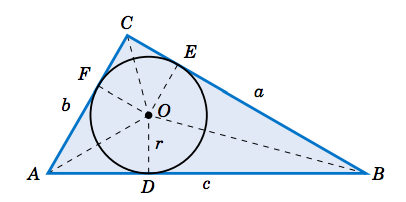
Allow \(r\) be the radius of the inscribed circumvolve, and let \(D \), \(E \), and \(F\) be the points on \(\overline{AB} \), \(\overline{BC} \), and \(\overline{Ac} \), respectively, at which the circle is tangent. So \(\overline{OD} \perp \overline{AB} \), \(\overline{OE} \perp \overline{BC} \), and \(\overline{OF} \perp \overline{AC} \). Thus, \(\triangle\,OAD\) and \(\triangle\,OAF\) are equivalent triangles, since they are right triangles with the same hypotenuse \(\overline{OA}\) and with corresponding legs \(\overline{OD}\) and \(\overline{OF}\) of the same length \(r \). Hence, \(\angle\,OAD =\bending\,OAF \), which means that \(\overline{OA}\) bisects the angle \(A \). Similarly, \(\overline{OB}\) bisects \(B\) and \(\overline{OC}\) bisects \(C \). We accept thus shown:
For any triangle, the heart of its inscribed circle is the intersection of the bisectors of the angles.
Nosotros will employ Effigy two.v.6 to find the radius \(r\) of the inscribed circle. Since \(\overline{OA}\) bisects \(A \), we see that \(\tan\;\frac{ane}{2}A = \frac{r}{AD} \), and so \(r = Advertizement \,\cdot\, \tan\;\frac{1}{2}A \). At present, \(\triangle\,OAD\) and \(\triangle\,OAF\) are equivalent triangles, and so \(Advertizing =AF \). Similarly, \(DB = EB\) and \(FC = CE \). Thus, if we permit \(southward=\frac{1}{2}(a+b+c) \), we meet that
\[\nonumber\begin{align*}
ii\,south ~&=~ a ~+~ b ~+~ c ~=~ (Advert + DB ) ~+~ (CE + EB) ~+~ (AF + FC)\\ \nonumber
&=~ AD ~+~ EB ~+~ CE ~+~ EB ~+~ Advertising ~+~ CE ~=~ 2\,(Advertizing + EB + CE)\\ \nonumber
s ~&=~ AD ~+~ EB ~+~ CE ~=~ Advertizement ~+~ a\\ \nonumber
AD ~&=~ southward - a ~.
\end{align*}\]
Hence, \(r = (southward-a)\,\tan\;\frac{ane}{2}A \). Similar arguments for the angles \(B\) and \(C\) requite us:
Theorem 2.10
For whatsoever triangle \(\triangle\,ABC \), let \(s = \frac{1}{two}(a+b+c) \). Then the radius \(r\) of its inscribed circle is
\[ r ~=~ (s-a)\,\tan\;\tfrac{i}{2}A ~=~ (south-b)\,\tan\;\tfrac{1}{two}B ~=~
(south-c)\,\tan\;\tfrac{1}{2}C ~.\label{2.38}\]
We also encounter from Figure 2.5.half dozen that the area of the triangle \(\triangle\,AOB\) is
\[\nonumber
\text{Area}(\triangle\,AOB) ~=~ \tfrac{1}{2}\,\text{base} \times \text{height} ~=~
\tfrac{one}{2}\,c\,r ~.
\]
Similarly, \(\text{Area}(\triangle\,BOC) = \frac{1}{two}\,a\,r\) and \(\text{Area}(\triangle\,AOC) = \frac{1}{ii}\,b\,r \). Thus, the area \(K\) of \(\triangle\,ABC\) is
\[\nonumber \brainstorm{align*}
K ~&=~ \text{Surface area}(\triangle\,AOB) ~+~\text{Surface area}(\triangle\,BOC) ~+~ \text{Expanse}(\triangle\,AOC)
~=~ \tfrac{i}{2}\,c\,r ~+~ \tfrac{1}{2}\,a\,r ~+~ \tfrac{one}{2}\,b\,r\\ \nonumber
&=~ \tfrac{1}{two}\,(a+b+c)\,r ~=~ sr ~,~\text{and so past Heron's formula nosotros go}\\ \nonumber
r ~&=~ \frac{K}{due south} ~=~ \frac{\sqrt{s\,(southward-a)\,(south-b)\,(s-c)}}{s} ~=~
\sqrt{\frac{s\,(s-a)\,(southward-b)\,(southward-c)}{s^2}} ~=~ \sqrt{\frac{(s-a)\,(s-b)\,(south-c)}{s}} ~~.
\end{align*}\]
Nosotros have thus proved the following theorem:
Theorem 2.xi
For whatsoever triangle \(\triangle\,ABC \), let \(due south = \frac{i}{2}(a+b+c) \). Then the radius \(r\) of its inscribed circle is
\[\label{2.39}r ~=~ \frac{Grand}{s} ~=~ \sqrt{\frac{(s-a)\,(southward-b)\,(s-c)}{s}} ~~.\]
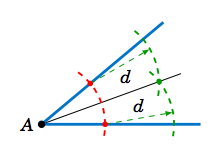
Recall from geometry how to bisect an angle: apply a compass centered at the vertex to draw an arc that intersects the sides of the bending at two points. At those two points use a compass to draw an arc with the same radius, big enough so that the two arcs intersect at a point, every bit in Figure 2.5.seven. The line through that point and the vertex is the bisector of the angle. For the inscribed circle of a triangle, you lot need only two angle bisectors; their intersection will be the center of the circle.
Instance 2.19
Find the radius \(r\) of the inscribed circle for the triangle \(\triangle\,ABC\) from Instance 2.6 in Section 2.2: \(a = ii \), \(b = 3 \), and \(c = iv \). Depict the circle.
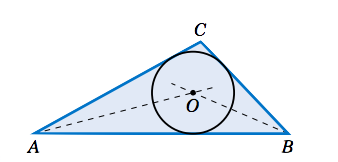
Figure 2.5.viii
Solution:
Using Theorem 2.eleven with \(s = \frac{i}{ii}(a+b+c) =\frac{1}{2}(2+3+iv) = \frac{ix}{2} \), we have
\[ r ~=~ \sqrt{\frac{(s-a)\,(s-b)\,(s-c)}{s}} ~=~
\sqrt{\frac{\left(\frac{nine}{2}-ii\right)\,\left(\frac{ix}{2}-3\right)\,\left(\frac{nine}{2}-
4\right)}{\frac{9}{ii}}} ~=~ \sqrt{\frac{5}{12}}~.\nonumber \]
Figure 2.5.8 shows how to depict the inscribed circle: describe the bisectors of \(A\) and \(B \), then at their intersection utilise a compass to draw a circle of radius \(r = \sqrt{5/12} \approx 0.645 \).
Source: https://math.libretexts.org/Bookshelves/Precalculus/Book:_Elementary_Trigonometry_%28Corral%29/02:_General_Triangles/2.05:_Circumscribed_and_Inscribed_Circles
0 Response to "Draw an Equilateral Triangle and Its Inscribed and Circumscribed Circles"
Post a Comment